































































































Lemonade candles from Instagram: why the glasses crack

You see it. A beautiful layered lemonade in a glass. The bottom is milky-white like condensed milk, the top is bright yellow like lemon juice. In the middle, a transparent slice of lemon, a sprig of mint, somewhere a tiny wick. The photo has 47,000 likes, the comment section glows with words like "dreamy", "summer vibes", "must try". You scroll further, come back, look at the address bar. Pinterest, board "candles I will make this summer". You pin it. Two weeks later, it's sitting on your kitchen windowsill. You light it, go get a coffee. You come back forty minutes later. The glass has a crack from the bottom to the rim, the lemon slice is blackened, and there's a puddle of dark oil on the counter with a fuel-like smell. This is not an unfortunate accident. It's physics.
What gel lemonade in a glass is chemically
That lemonade in a glass is not wax. Under the label "lemonade candle", what is typically sold is polybutene (CAS 9003-29-6) or a mixture of mineral oil (CAS 8042-47-5) with 5 to 10% styrene-isoprene-styrene copolymer (SIS). It is the SIS that gives the gel its characteristic transparency and desirable consistency, reminiscent of a liquid. The commercial standard is Penreco Versagel, whose technical data sheet clearly states that the material does not belong in containers with organic additives and requires non-flammable insulation from the container walls.
The second layer in the lemonade is usually white soy or paraffin wax. It is precisely the combination of two materials with different thermal expansion coefficients that forms the core of the problem. Soy wax melts at 49 to 55 °C, paraffin around 58 °C, but the gel component needs 80 to 100 °C to remain sufficiently fluid. A wick lit in the upper gel layer has no way to reach the lower wax layer evenly. Either the heat flows downwards and the bottom starts cracking from thermal expansion, or the gel on top seeps into the wax, creating a hybrid mixture that burns unpredictably.
How to recognize gel in a photo from an e-shop
Gel has a glassy transparency with visible bubbles or inclusions. Classic vegetable wax is matte, opaque, white or yellowish depending on the shade. If you see a liquid layer in the photo with a piece of fruit or herb inserted into it, it is the gel component. Real wax only contains decoration on the surface, never inside the mass. From 40 centimeters away, it looks like a mixed cocktail. From a chemical perspective, it is a rich fuel supply ready to ignite.

Why the Insta-glass cracks on the first lighting
The glass in which most gel candles from the social media hit live is soda-lime glass. Cheap, transparent, available, mass-produced. Soft drink glasses, IKEA glasses, drugstore vases are also made from it. Soda-lime glass can withstand a temperature difference between the inner and outer wall of approximately 35 to 40 °C before cracking (the exact value depends on wall thickness and manufacturing quality; decorative glasses from mass-market production typically fall within a 30-40 °C delta). This number is not marketing; it is a mechanical property of an amorphous material called the coefficient of thermal expansion.
Borosilicate glass, used in laboratory equipment and premium candles, can withstand a difference of around 165 °C. Borosilicate glass type 3.3 according to ISO 3585 (Pyrex EU) achieves a thermal shock resistance of up to 300 °C delta. The price for borosilicate glasses is 4 to 5 times higher than for soda-lime, which is why they are almost never used for decorative candles from trendy pictures. You can recognize borosilicate by its weight (it is denser) and by the color of its edge (a slightly greenish tint compared to the pure transparency of soda-lime).
Specific scenario: first lighting, the glass is in a room at 22 °C. After 30 minutes, the inner wall right next to the melted gel has a temperature over 85 °C. The outer wall, still being cooled by the room air, stays around 45 °C. The difference is 40 °C, right on the edge. It is enough for the glass to be in a draft from an open window, or in a sunny window with asymmetric heating, and the delta jumps to 50 °C. It cracks. Sometimes silently, sometimes with a sharp crack and a spreading puddle of hot oil.
When it cracks, it is not about one small fissure. It is often a two-phase collapse: the first crack forms at a 35 °C delta and the glass holds because the gel is still supporting it from the inside. The second crack comes only when the gel starts flowing through the first one and the hot material transfers the temperature to a part of the wall that hasn't been heated yet. At that moment, the glass splits along one line and the contents spill out like a liquid torch across the counter or table. The NFPA Candle Fires Report 2023 classifies this scenario as a primary cause of candle fires in the kitchen and states that candles account for approximately 3% of all reported home fires and approximately 6% of home fire injuries in the USA.






A slice of lemon, a sprig of mint, and a piece of cinnamon
The aesthetic of lemonade candles relies on decorating the interior. A dried lemon slice attached to the wall, a mint sprig encased in gel, a decorative cinnamon stick by the wick. From a chemical perspective, it is a rich fuel supply. Dried lemon slice contains d-limonene, a volatile component of citrus peel, which has a flash point of 48 °C (closed cup test). This is a temperature that the gel candle in the vicinity of the burning wick reaches within a few minutes (the gel needs 80 to 100 °C to remain fluid). The organic matter of the slice itself, mainly cellulose and residual sugars, ignites around 200 °C.
Upon contact with an unstable flame or with hot gel spilling onto the edge of the slice, a single spark is enough for the fruit to become a second wick. The flame spreads along the inner wall of the glass and the temperature locally jumps over 400 °C, which no standard glass can withstand. A cinnamon stick is even worse. The woody cellulose of cinnamon (Cinnamomum verum) ignites at 232 °C, but as a thin structure with a large surface area, it holds fire for minutes and glows like a miniature torch. English DIY forums archive hundreds of stories about cinnamon candles that looked normal during three hours of burning and in the fourth hour set a tulle curtain on fire.
One more detail that is never mentioned in viral tutorials: when the cinnamon stick in the gel burns down along the wick, it doesn't go out like a match. It smolders. Sometimes it smolders for hours after you've extinguished the candle and gone to sleep. Smoldering cellulose is a term firefighters know well, because smoldering can last for hours without a flame before suddenly igniting — and often at night when no one is watching. With a candle containing a stick on the windowsill, the risk of nighttime re-ignition is real and remains open until your gel lemonade becomes a souvenir from the insurance company.
The most common flammable additives in Pinterest candles
Lemon, orange, and lime slices (200 °C). Rosemary sprigs (215 °C), lavender (210 °C), mint (220 °C). Dried rose petals (205 °C). Cinnamon sticks (232 °C) and cloves (228 °C). Pine cones and pieces of bark (210 °C). None of these additives belong inside a burning candle. It is safe to place them next to the candle as decoration on a tray, not in the wax.

Soot you don't see, but breathe
Even if the gel candle withstands cracking (let's say it's in the right borosilicate glass and has no internal decorations), the question remains of what is released into the air. Polybutene, as a liquid hydrocarbon, burns with a higher soot production than vegetable wax candles. Since the gel is essentially a liquid petroleum hydrocarbon, it produces significantly more PM2.5 particles during burning than a comparable soy or coconut candle over the same burn time — similar to paraffin, which is also petroleum-based. PM2.5 are fine dust particles smaller than 2.5 micrometers, meaning they penetrate deep into the lungs.
In 2025, Nature published a review study on indoor PM2.5 sources in households, where candles are listed as a moderate source in combination with gas stoves and fireplace inserts. The specific indoor concentration depends on room size, ventilation, number of candles, and burn time. For reference: the WHO recommends a long-term exposure limit for indoor PM2.5 below 15 micrograms per cubic meter (24-hour average). Three gel candles burning simultaneously in a 20-square-meter room without ventilation will exceed this limit within an hour. Three soy candles of the same size over the same period remain below the limit.
Another element that complicates gel candles is the scent. Polybutene itself is almost odorless, but during burning, tiny traces of mineral oil oxidize into compounds that resemble the smell of old engine oil in a garage. To mask this odor, manufacturers add synthetic fragrances in concentrations of 8 to 15% w/w. These synthetic scents are a mixture of 100 to 300 unspecified compounds, often with phthalates as fixatives. In 2023, ScienceDirect published an analysis of synthetic fragrance emissions during burning, and in one study, increased concentrations of formaldehyde and acrolein were measured in the breath of subjects after one hour in a room with three synthetic gel candles.
Practical soot test above the candle
Extinguish the candle after three hours of burning and look at the black marks above it. If you see a dark trail on the ceiling or a visible layer of soot above the wick in the glass, you have a high-emission candle. With a properly made soy or rapeseed candle, the trail is invisible even after ten hours of cumulative burning. Brief ventilation (open window) after each hour of burning significantly reduces the PM2.5 concentration in the room.








Safe distances from flammable surfaces
When a candle burns, it creates not only a flame but also hot rising air currents, known as a convection chimney. These currents reach temperatures of 80 to 110 °C above the flame and decrease with height. With this type of viral aesthetic lemonade, the problem is worsened because the gel flows at 80 °C and the wick sinks lower into it, thereby increasing the flame height above the glass. The flame is normally 25 to 40 mm, but when the wick sinks, it can lengthen to 60 to 80 mm.
Safe distances from immediate flammable surfaces: 30 cm from curtains, 10 cm from walls and tiles, 50 cm from the ceiling (especially with wooden or paper wallpaper ceilings). Never place the candle on a windowsill under a curtain, on a television, or on a drawer that opens towards you. In the kitchen, a risky spot is next to an electrical switch, as splashing water during cooking can damage the edges of the glass. The candle glass heats up on the outside to 60 to 90 °C during prolonged burning, so with a Pinterest candle in the kitchen or on a dresser, always place a ceramic or metal coaster under the glass with a diameter 2 cm larger than the glass.

The wick in a Pinterest candle and what that metal wire does
When unpacking a cheap gel candle, you often find a thin metal reinforcement in the wick. It looks like regular steel, but in older models (especially imports from unregulated sources), it may contain lead. European manufacturers voluntarily phased out lead wicks in the 1970s and 1980s, and some countries later explicitly banned them (for example, Finland and Denmark since 2001), but imports from non-EU sources are not strictly covered by regulations. (The year 2008 is often mistakenly cited — that is the date of the US CPSIA law, not the EU.) Lead releases traces into the air during burning and gradually accumulates in the body, especially in children under 6 years old.
A safe wick is pure cotton or with a wooden reinforcement (wood wick). When burning, a wooden wick crackles slightly and emits a quiet sound similar to burning wood in a fireplace. A cotton wick of the ECO or CD type has a short code on the packaging: CD-10 for a 6 cm diameter, CD-14 for 8 cm, CD-18 for 10 cm (CD = "Cotton-paper Dual" core). The wick thickness is determined by the container diameter and wax type. A rough rule for soy wax: 1.5 mm wick thickness for every cm of diameter, for paraffin 1.2 mm/cm. A wick that is too thick means a pushed flame and higher soot emission, while one that is too thin means tunneling and leftover wax that never burns.
Home wick test before the first burn
Gently pull the wick up so you can see its core. If it has a metal core, a magnet should react slightly. Lead is not magnetic, zinc is slightly magnetic, and steel is strongly magnetic. With a lead wick, a magnet will show no interaction; a zinc wick will hold weakly; a steel wick will hold firmly. Second test: light the wick outside the candle (a 5 mm piece). A cotton wick with a wooden core burns steadily. A lead wick produces tiny metal sparks and a gray-blue flame. If you see these signs, throw the candle away immediately.
A warranty you will never get
Returning a defective candle that cracked after its first burn is nearly impossible. The National Candle Association (NCA 2023), the American industry association that writes safety recommendations for most candle manufacturers worldwide, warns in its safety guidelines specifically about decorative candles with solid inclusions inside and unevenly thick glass — exactly what makes lemonade candles risky. The European CEN standard system has a similar formulation in EN 15493 (candle safety requirements).
Etsy and Shein manufacturers either do not know this nuance or ignore it. They sell lemonade candles without a safety label and without burning instructions, which CEN requires. When your glass cracks, the manufacturer will respond with something like "every candle is unique, results may vary, refund is not available for handmade items." For this category of decorative candles with dry inclusions, buyers generally cannot win a complaint through the conflict resolution process on platforms like Etsy. Etsy internally classifies such products as art objects, not functional candles, and manufacturer safety responsibility does not apply.
For the buyer, this means one thing: if you buy a decorative gel candle with lemon slices and it burns down your kitchen, the insurance company will deny the claim (the candle had no CE marking or EN 15493 label) and the manufacturer will refuse a refund (they sold you an art object). You will end up repairing the wall and cleaning soot that has embedded itself in the paint. The US CPSC records thousands of candle-related injuries in American households every year, with decorative candles containing non-standard contents making up a significant portion. The main injury categories: burns from spilled liquid wax, cuts from glass shards when the glass cracks, and smoke inhalation from smoldering additives.
How to make a nice gradient without gel
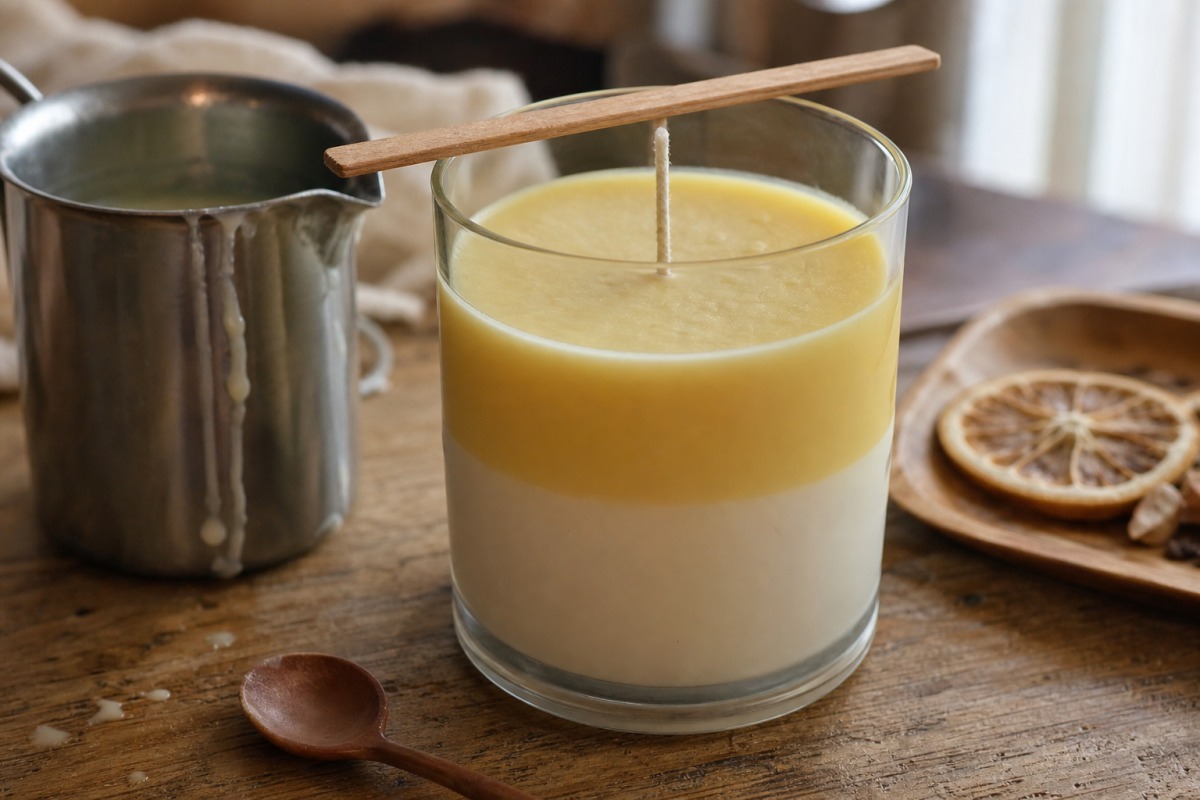
Creating a two-layer or three-layer candle is a completely legitimate technique, and hundreds of craft makers do it safely. The trick lies in two things: use soy or rapeseed wax (not gel) and no solid inclusions inside. You can achieve the aesthetic of a lemon candle even without physical slices inside. A yellow top layer with titanium yellow pigment, or a small piece of lemon zest pressed into a paraffin sheet on the surface (not inside) of the candle. Visually 80% of the effect, risk of ignition 0%.
Procedure for a two-layer soy wax candle at home
A 250 ml borosilicate glass, 100 mm high. A CD-12 or ECO-14 wick tied to a wooden stick across the top of the glass. Melt 150 g of Golden 464 or C3 soy wax at 75 °C, add 6% fragrance oil that follows the IFRA standard (lemon or mint component). Add natural pigment (yellow ochre oxide 0.1% or yellow mica powder) and stir for 60 seconds. Slowly pour only the bottom half into the glass (approx. 75 g) and let it set for 60 minutes. Melt a second batch of 75 g of wax at 65 °C without pigment (or with white TiO2 pigment). Slowly pour the top layer over a wooden spoon to prevent it from mixing with the bottom layer. Let it sit for 24 hours before the first burn.
Essential oils, NOT synthetic fragrances
You make the lemon-mint composition with a blend of essential oils, NOT a synthetic "lemonade" fragrance with 200 unspecified compounds from a petrochemical base. The safe concentration of essential oils in soy wax is 6 to 12% w/w. IFRA standards limit specific fragrance components according to the category of use. For candles (IFRA category 12), citral is not concentration-limited — the practical ceiling is how much fragrance the wax can hold, typically 6 to 12% of the composition concentration. Stricter limits on citral apply to cosmetics that remain on the skin.
First burn test (memory burn)
A homemade soy candle needs a so-called memory burn on its first use: you light it for long enough that the entire top layer of wax melts to the edge of the glass. For a 7 cm diameter, this means 2 hours of continuous burning; for 10 cm, 3 hours. If you shorten the first burn to 30 minutes, the candle will remember a narrow tunnel, and every subsequent burn will follow the same path. This detail is completely missing from Pinterest tutorials and is the reason why you remember half of your DIY candles from past Christmases as the ones that didn't burn evenly.
Decision tree: how to choose a candle that suits you
After reading the physical facts, every buyer falls into one of four categories. Here is a decision tree to help you find your own answer.
Path 1: I want Pinterest aesthetics without compromise
Solution: A homemade two-layer soy wax candle with pigment in a borosilicate glass. Material cost: 4 to 6 euros per glass. Production time: 1 hour + 24 hours of setting. Advantages: you have full control over the composition, you choose a fragrance oil that follows the IFRA standard, and you use glass that won't crack. Disadvantages: it won't be perfect on the first try; the first two glasses may have an uneven layer or cracks.
Path 2: I want a nice product and save time
Solution: Buy a premium handcrafted candle from a small studio that declares the material (soy, rapeseed, or beeswax), fragrance oil that follows the IFRA standard, and a borosilicate container. Price: 18 to 35 euros per piece. Advantages: you get declared ingredients, beautiful aesthetics, and a long lifespan of 30 to 50 hours of burning. Disadvantages: a higher one-time investment compared to a 14-euro DIY lemonade kit.
Path 3: I need a decoration, not a candle
Solution: Buy an empty borosilicate glass and place a lemon slice with mint inside as a visual element. Complement it with an LED light or a flameless candle (battery-operated candle with a simulated flame). Price 8 to 12 euros per set. Advantages: you get the exact Instagram aesthetic without any risk of thermal shock or fire. Disadvantages: you lose the aromatic component of a real candle.
Path 4: Hybrid solution, decorative glass + real candle next to it
The fourth combined option for the discerning: you split the aesthetic and function into two objects. On a tray, place a beautiful decorative glass with a lemon slice, a mint sprig, and a battery-operated LED light (Pinterest visual). Next to it, place a safe soy candle in borosilicate, which provides real flame light and a lemon scent for the entire room. With this trick, you get a full aesthetic that looks like a single candle in a photo, but physically bypasses all thermal shock and fire risks. The price of the entire set ranges from around 25 to 40 euros.
Lemonade candles from community boards are a marketing trick on the human brain. Aesthetics will get you 47 thousand likes, physics will get you a cracked glass and loss of insurance claim entitlement. The choice is in your hands.

Mother of two daughters, wife of Roman and the heart of our creative studio. Besides writing blogs, she dedicates herself daily to the handmade production of candles and decorative containers — she knows the materials, knows what lasts and what simply delights the home. She looks at jewelry, watches and fashion accessories from real family practice: what serves, what endures and what truly brings joy.
All articles by author




Comments
Add comment
Login required
To add a comment, you must log in to your account.
Don't have an account? Register